
Powered By



Some people experience migraine attacks that involve facial pain, which can also be called orofacial pain. This facial pain is most common in the forehead, periorbital region (“behind the eye”), cheeks, and sometimes the jaw and temples, but it can appear anywhere on the face, including along one or both sides.While it’s rare to experience facial pain as the only symptom of migraine, one study showed that about 9 percent of people experience facial pain alongside other migraine symptoms.
Interestingly, the research also found that people with migraine and facial pain showed more specific symptoms, such as eye redness, excessive tearing, eyelid swelling or drooping, nasal congestion, and facial flushing, compared to people with migraine without accompanying facial pain.
If you’re experiencing facial pain during migraine attacks, with or without some of the above-mentioned symptoms, it may be important to see a doctor to rule out other causes of pain in your face.
Here’s what you need to know so you can get a sense of how face pain can present with migraine, and make educated decisions about your healthcare and treatment plan.
On MyMigraineTeam, a number of members have talked about experiencing facial pain during a migraine attack. Their comments illustrate a number of ways that facial pain can show up.
One member found that facial pain meant a migraine attack was coming. Their skin even became sore to the touch. They shared, “I can feel my migraine coming on because on the left side of my face, it’s tingling on my cheek and in my mouth and lips. It’s painful to touch my face on the left side.”
A number of members talked about face pain along with pain in other locations. One said, “I’m having one of my worst days. My face is hurting so bad. It’s also in my ear.”
Another added, “Woke up with a horrible headache, the bridge of my nose and the base of my skull hurts so bad!”
Members also talked about different types of pain in different parts of their faces. “It’s the whole top of my head, across the bridge of my nose, where it’s extremely painful. It feels like my nose is in a vice grip, but I still can breathe,” one explained.
“I get a tightening of muscles in my forehead and sometimes in my cheeks,” another said.
In fact, the forehead seems like a relatively common place to experience facial pain during a migraine headache. “Does anyone feel like there’s fire in your forehead?” one member asked.
Another shared, “So I woke up with an awful migraine headache two hours ago. … Feels like someone had drilled my forehead with a drill on both sides.”
Sometimes, facial pain interfered with members’ daily routines. “Missed work today, so much pressure and pain in my face, and my eyes feel heavy and keep blurring out on me,” one person said.
As illustrated by members above, facial pain in relation to migraine can be quite different for everyone in terms of location and sensation.
However, it seems that the facial pain accompanied by a migraine attack is more pressure-based, with a sensation of compression or weight in or behind the middle of the face where the forehead, nose, and eyes meet. This can be confusing for some people who are used to more classic migraine sensations of throbbing or pounding in the side or the back of the head.
Therefore, many people mistake this kind of pain for sinus problems rather than a migraine attack, which isn’t surprising given the feeling of pressure in that area.
Aside from sinus infection or chronic sinus inflammation, facial pain may also be connected to other conditions that are, in turn, also connected to migraine.
Because face pain may not occur with every migraine attack and can be confused with or related to many different conditions, it may be difficult to diagnose the cause.
It’s also possible that the 9 percent figure mentioned above may be significantly lower than the actual number of people who experience facial pain with migraine.
Temporomandibular disorders (TMD) are a common cause of significant face pain. People with TMD have issues with their temporomandibular joint (TMJ), the main joint of the jaw, or with the muscles and other tissues that make the jaw work.
TMD is also connected to migraine, with migraine being the most common type of headache disorder experienced by people with TMD. TMD may make migraine worse and make it more likely that attacks will become chronic. If you’re living with both of these conditions, it can be difficult to know which one is causing your facial pain or if they’re somehow working together.
Trigeminal neuralgia is another disorder that’s a leading cause of facial pain. This is a nerve disorder in which you experience sharp, electrical, shooting pain in the trigeminal nerve (primary nerve in your face). The pain can be triggered by things that don’t usually cause pain, such as lightly touching your face, brushing your teeth, talking, or chewing. This nerve and its pathways can also be activated by both TMD and migraine.
More research is needed to fully understand how these diagnoses interact with each other. If you experience facial pain with migraine, you may want to talk to your neurologist about whether other medical conditions could be influencing both your facial pain, and triggering or worsening your migraine attacks.
Facial pain isn’t always caused by migraine, even in people who live with that diagnosis. It can also be caused by:
If you’re experiencing face pain that occurs by itself without other migraine symptoms, is new and without a known cause, goes away and comes back, or is getting worse, it’s time to see a doctor. If you think your teeth might be involved, you should seek out a dentist.
Sometimes, face pain may indicate an emergency. If it shows up with these other symptoms, get urgent help. Look for:
A doctor can give medical advice and help you get to the bottom of what’s causing your facial pain so you can get on a treatment plan that addresses the underlying cause. This gives you your best chance of keeping your quality of life and sense of wellness high.
If you experience facial pain as part of migraine attacks, make sure your headache specialist knows about it. It can be helpful to track your migraines using an app or a journal. That way, you’ll have a record of all aspects of your migraine attacks, including facial pain.
On MyMigraineTeam, people share their experiences with migraine, get advice, and find support from others who understand.
Does your face hurt during migraine attacks? Let others know in the comments below.
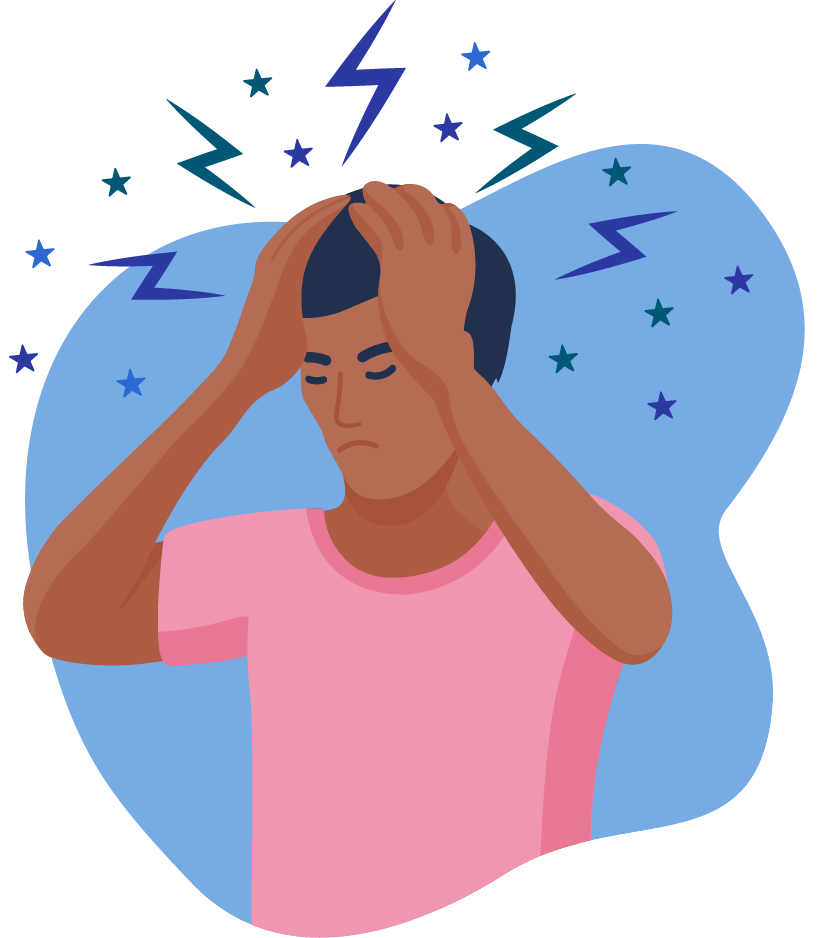
Are your headaches a symptom of migraine? Get a quick assessment.
Get updates directly to your inbox.





 Continue with Facebook
Continue with Email
Continue with Facebook
Continue with Email
Continue with Facebook
Continue with Email
Continue with Facebook
Continue with Email
Become a member to get even more





 Join
Join



 Your Privacy Choices

This is a member-feature!
Sign up for free to view article comments.
We'd love to hear from you! Please share your name and email to post and read comments.
You'll also get the latest articles directly to your inbox.